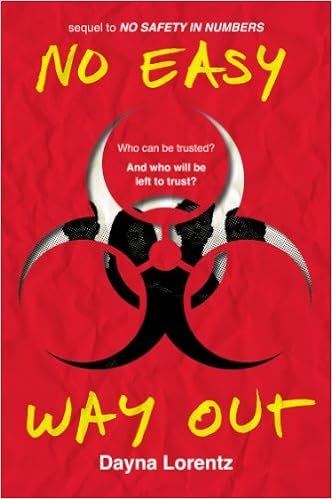
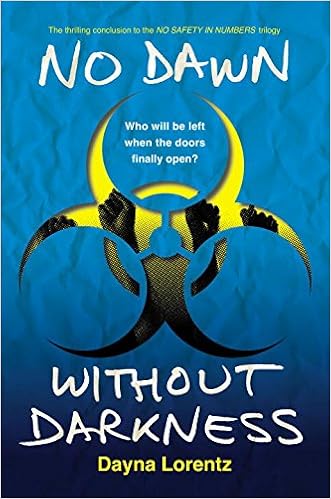
At the recommendation of our daughter, I just completed Dayna Lorentz's young adult No Safety in Numbers trilogy which consisted of :
No Safety in Numbers, No Easy Way Out and No Dawn without Darkness


The series is focused on a group of teenagers who are trapped in a shopping mall when a terrorist sets off a bomb that exposes everyone in the mall to a highly contagious, deadly flu virus and the Government seals off the mall to protect the rest of the world's population from the deadly virus. Throughout the series the Government, the adults, and the people in the mall all behave badly in a "Lord of the Flies" type of environment. Since it is written for teens and the lead characters are teens, the beginning of the series the characters are interested in boyfriends/girlfriends, parties, school sports rivalries and fashions. By the end of the series they have evolved to pure survival.
I believe the story in many ways was believable and that the characters in the book seemed to be well-enough developed. Dana Lorentz evolved the story so that the disaster seemed to continually evolve to a more horrible situation. The first two books were good, but the third volume seemed to wrap up the crisis early in the book and the after effects seemed somewhat anticlimactic and not very interesting. She needed to introduce some sort of suspenseful situation into that part of the book. The mall was a huge, complicated structure and the characters moved from store to store via main hallways, parking garages and service halls. It was hard for me to visualize where they were and how far they were from each other. I think the book would have been much easier to understand if she had included some sort of sketch or "map" of the mall showing the locations of the stores, hallways, escalators, parking garages etc. The map could have been on the back cover of the book, for example. The story chapters moved from focus on one character at a time as experienced by that character. The decisions being made by leaders and Government individuals was ignored, since the focus was primarily on the teen main characters. As an adult, I suppose, I would have been more interested in reading some of those political thought processes and decisions that had to have been made.
I think the series does point out some concerns that America should think about before some sort of similar crisis would hit us. In some ways, it does appear that what happened to these people would happen today. Government and Center for Disease Control leaders would have to make some similar, very difficult, decisions to quarantine people in a mall, cut off their communications and leave them to die. It sounds very inhumane, but could be the prudent decision to protect the rest of the community, nation, or the world from a cataclysmic disaster that could kill hundreds of millions of people.
In the books, the Government and leaders made several decisions that seemed cruel. I wonder if we had such a similar crisis, would Government make similar decisions? Do first responders and CDC perform exercises for this sort of situation? Do they perform round-table discussion of these scenarios and build checklists for the possible various contingencies? Some of the decisions that seemed cruel were:
1. All people were thrown in one "basket" in the mall, instead of segregating them to try to isolate pockets where people stay healthy from people who are sick. Healthy people could continue to be screened, moved to locations where they could eventually be removed from the mall.
2. Most communications between the public and the denizens of the mall was cut off. Cell phone calls were blocked and even CB radio was limited and then cut off. The apparent goal was to prevent the public from being put into a state of fear and panic about the disease. Censorship was done on the limited communication that did occur. It seems to me that that was the one decision that really drove the storyline, because the people in the mall no longer knew what was going on outside the mall, and lost touch with their family--and lost hope. Would the Government really want to do that? Is that part of the CDC plan for such a situation?
3. Within the mall itself there was only limited communication between the leadership and the residents. It appeared that public announcements only were made on rare occasions. It seems to me that announcements and local "broadcasting" should have been almost continuously,
4. Food, medicine and supplies were apparently severely restricted or limited from the outside. People inside the mall had to fight for food, flashlights etc. In a real situation, where thousands of people are trapped, wouldn't the 'outside world" be willing to provide a regular supply of necessary supplies? How would they be delivered to prevent contamination?
No Safety in Numbers, No Easy Way Out and No Dawn without Darkness

The series is focused on a group of teenagers who are trapped in a shopping mall when a terrorist sets off a bomb that exposes everyone in the mall to a highly contagious, deadly flu virus and the Government seals off the mall to protect the rest of the world's population from the deadly virus. Throughout the series the Government, the adults, and the people in the mall all behave badly in a "Lord of the Flies" type of environment. Since it is written for teens and the lead characters are teens, the beginning of the series the characters are interested in boyfriends/girlfriends, parties, school sports rivalries and fashions. By the end of the series they have evolved to pure survival.
I believe the story in many ways was believable and that the characters in the book seemed to be well-enough developed. Dana Lorentz evolved the story so that the disaster seemed to continually evolve to a more horrible situation. The first two books were good, but the third volume seemed to wrap up the crisis early in the book and the after effects seemed somewhat anticlimactic and not very interesting. She needed to introduce some sort of suspenseful situation into that part of the book. The mall was a huge, complicated structure and the characters moved from store to store via main hallways, parking garages and service halls. It was hard for me to visualize where they were and how far they were from each other. I think the book would have been much easier to understand if she had included some sort of sketch or "map" of the mall showing the locations of the stores, hallways, escalators, parking garages etc. The map could have been on the back cover of the book, for example. The story chapters moved from focus on one character at a time as experienced by that character. The decisions being made by leaders and Government individuals was ignored, since the focus was primarily on the teen main characters. As an adult, I suppose, I would have been more interested in reading some of those political thought processes and decisions that had to have been made.
I think the series does point out some concerns that America should think about before some sort of similar crisis would hit us. In some ways, it does appear that what happened to these people would happen today. Government and Center for Disease Control leaders would have to make some similar, very difficult, decisions to quarantine people in a mall, cut off their communications and leave them to die. It sounds very inhumane, but could be the prudent decision to protect the rest of the community, nation, or the world from a cataclysmic disaster that could kill hundreds of millions of people.
In the books, the Government and leaders made several decisions that seemed cruel. I wonder if we had such a similar crisis, would Government make similar decisions? Do first responders and CDC perform exercises for this sort of situation? Do they perform round-table discussion of these scenarios and build checklists for the possible various contingencies? Some of the decisions that seemed cruel were:
1. All people were thrown in one "basket" in the mall, instead of segregating them to try to isolate pockets where people stay healthy from people who are sick. Healthy people could continue to be screened, moved to locations where they could eventually be removed from the mall.
2. Most communications between the public and the denizens of the mall was cut off. Cell phone calls were blocked and even CB radio was limited and then cut off. The apparent goal was to prevent the public from being put into a state of fear and panic about the disease. Censorship was done on the limited communication that did occur. It seems to me that that was the one decision that really drove the storyline, because the people in the mall no longer knew what was going on outside the mall, and lost touch with their family--and lost hope. Would the Government really want to do that? Is that part of the CDC plan for such a situation?
3. Within the mall itself there was only limited communication between the leadership and the residents. It appeared that public announcements only were made on rare occasions. It seems to me that announcements and local "broadcasting" should have been almost continuously,
4. Food, medicine and supplies were apparently severely restricted or limited from the outside. People inside the mall had to fight for food, flashlights etc. In a real situation, where thousands of people are trapped, wouldn't the 'outside world" be willing to provide a regular supply of necessary supplies? How would they be delivered to prevent contamination?

No comments:
Post a Comment