Wednesday, September 24, 2014

Denialism by Michael Specter

The premise of the book is that on many important world issues, backward thinking and mistrust or misunderstanding of science is making our problems worse.  I certainly agree with him!

Michael Specter has a very good description of how just a few people have created mistrust of vaccines and now many children are getting sick because of it.  He also does a good job of exposing the fraud in believing that organic food is significantly better for our health or for the world.....  If everyone in the world suddenly switched to only eat organic food, the world wouldn't be able to support its current population.  He also pokes fun at the practice of taking nutritional supplements.  Some of his arguments for the organic food and supplements are a little weak, and he doesn't follow a clear set of logic.  For both of these issues, it isn't clear where "denialism" comes into play.  I think both organic food and supplements industries are the result of very clever and effective marketing.

Then he took on the issue of race and ethnic background and DNA.  That section seemed to focus on how all humans are more alike and that race shouldn't be a discriminator when doing medical studies.  It had some good scientific information, but didn't seem to be relevant to the "denialism issue"..

His final big section concerned the development of GMO organisms.  He presented a good case why research in all genetic modifications should continue as it may be the human race's only saviour from disaster.  There are many people and organizations, such as religious groups who are opposed to "fooling with mother nature" and this minority has been able to put the brakes on development.  I don't believe he handled this subject very thoroughly.

I would have liked to have heard his suggestions on how citizens could work to reverse the denialism in the world -- in particular for each of the issues he raised.  I'm not sure there is a solution.  The Catholic Church's denialism kept the world in the "Dark Ages for many centuries.  Some of the world's religions are still doing it.  I would have also thought if he wanted to cite some of the best examples of denialism, he would have cited global warming where a very few, very rich people, like the Koch Brothers, have been able to create enough doubt to slow down all progress to stop or reverse global warming.  Also he could have addressed recreational drugs, such as marijuana which has a small minority of "special interests" who have been fighting against legalization for decades which has resulted in destroying many lives and exported corruption to central American countries. 

The Last Drop by L. Ron Hubbard

I really liked a couple of Hubbard's Science Fiction books.  This book was supposed to be humorous, but I think it must have been one of Hubbard's earlier short stories --part of his "pulp fiction" era.

The characters weren't developed well, and the premise -- a drink that can make you bigger or smaller seems like it probably came from Alice in Wonderland.

Sunday, September 7, 2014

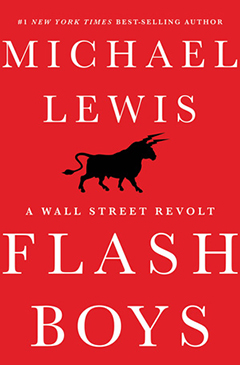
Flash Boys by Michael Lewis

I thought this book was an excellent description of one of the biggest wall street cheating scandal of recent years.  It describes how he uncovered what the "high frequency traders" were doing to make so much money.  In effect they were "in front" of the market so they made a few cents on almost every trade.
The brokerages all knew it was illegal, and they kept what they were doing under wraps.  I don't think our SEC was doing it's job, and I don't believe that all of the perpetrators were caught, nor properly prosecuted for doing it.  The technique was so exotic that it would be difficult to explain to a jury. 

The Racketeer by John Grisham

Good book!  Typical John Grisham style with good plot twist and a proper ending.  Takes place in South East US, and involves men in prison, bribes etc.  

The Lifecycle of Software Objects by Ted Chianghttp://subterraneanpress.com/images/sized/magazine_covers/fall2010-425x561.jpg


This was a nice, short "novella" and was apparently a Hugo Award nominee.  Ted Chiang imagines a world in the near future where virtual characters begin to develop rudimentary forms of intelligence, and can learn and develop--much like a human child.  With computers continuing to improve at a rapid pace, and artificial intelligence software improving, the world as he describes it could happen!
Here is a link I found where you can read the short book online:
http://subterraneanpress.com/magazine/fall_2010/fiction_the_lifecycle_of_software_objects_by_ted_chiang

America by Dinesh D'Souza

This guy hates Obama and all of his writing seems to try to discredit Obama.  Hislogic is very difficult to follow, and he cherry picks" facts to make her case.  He also makes broad statements of why liberals believe one way or another --and usually it is based upon some trivial reason, rather than a "big picture" concept.
I believe it was written as a piece of right-wing propaganda -- and it was well written for that purpose.  I believe it was also made into a movie.  I would suspect that the "Tea Party" is behind the book and the movie, and it was probably totally funded by the Koch Brothers..
He seems to believe that America is still the "Greatest" --but that Liberals are destroying the country.  He also implies that the world is a "zero sum" game -- so that if another country is successful (has a larger GDP for example) that it would be bad for the US --we would be "losers" because another country did better.  .
Yes, if America wasn't around, the world would be different.